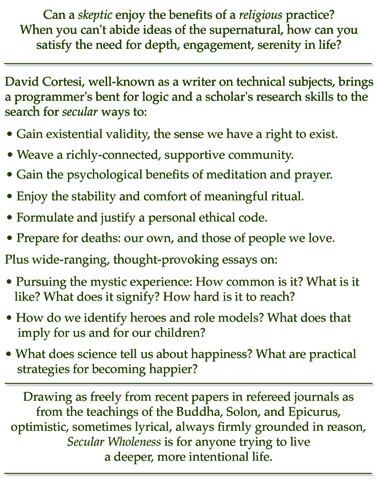




Here's the scoop
on the back cover:
Scroll down for
author and
cover info.
Contact me
by email.
Oh, they aren't wrong about gods and religion! I'm with those atheist warriors all the way. But they aren't pioneers; the great Robert Ingersoll was ripping up religion in popular lectures in 1870, and Tom Paine demolished the Bible a century before that. The emptiness and illogicality of religion has been obvious for a long time, to anyone who wants to see it.
Yet religious belief rolls right on. Why? Why do smart, sensible, practical people keep putting time, effort, and money into religious practices? The anthropologist's answer: because their investment repays them with valuable goods that they don't get elsewhere. Of the modern atheist writers, only Dan Dennett gets this; and he only wants to study it. None of them seem to see that atheism will never be an alternative until it can compete with what religion really offers.
See, religion isn't true, but religions work...as delivery systems for psychological benefits. Every church is a one-stop shop for an array of useful, important, mental and emotional comforts. That's one reason the religion habit is hard to kick: if you give it up, you give up all kinds of fellowship, emotional comforts, and useful certainties.
But are people who have no religion denied those comforts? Of course not! We just have to be a little more flexible in our shopping. This is a sourcebook showing where you can get for free, the goods for which believers sell their souls, or at least their consciences.
I'm a retired techie, a bike rider, some days a Buddhist, a compulsive explainer, an amusing, if occasionally pompous, speaker.
I was a programmer at IBM in those high and far-off times when computers weren't personal. With the dawn of the PC revolution I became a free-lance writer and columnist, and published several books including Inside CP/M, Dr. Dobb's Z80 Toolbook, and The Programmer's Essential OS/2 Handbook. Later I contributed to software and hardware manuals at Informix and at Silicon Graphics.
In retirement I want to continue to use the skills of research and organizing that were useful in explaining computers, but to apply them to subjects that are more worthy—or at least, less ephemeral. Secular Wholeness is the product of two years research amid the rich resources of the Green Library at Stanford and the Internet.
The cover design is by Dany Galgani, a superb illustrator whose work you can see at galgani.com.
The cover elements are: a galaxy as imaged by the Hubble Space Telescope, alder leaves, and a mayfly. It's based on these words from Chapter 2:
Our lives, compared to the stars, are tinier than a mayfly's life compared to the alder tree's. Yet we can describe the birth and death of stars!